Leopard spots are make-up girls put on their forehead to look like the spots on a leopard.

Cece Frey leopard spots
play_arrow4:35 Cece Frey sings Christina Aguilera with leopard spots on X Factor
play_arrow5:42 Ends with a foot wiggle at the end of the song

Leopard spots explained
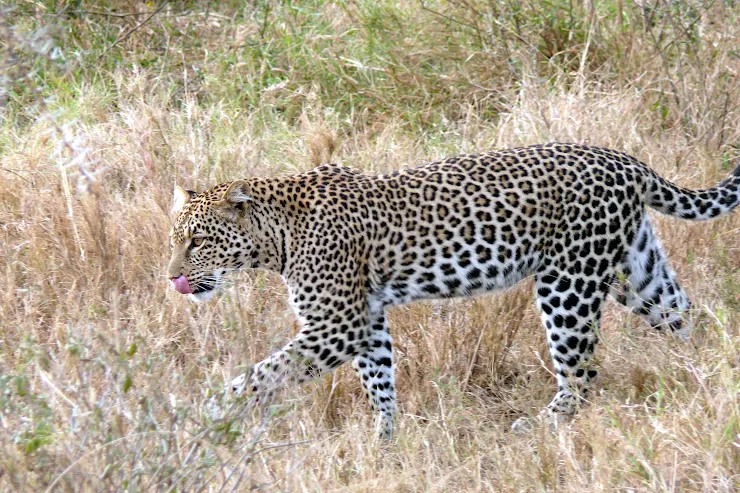
Leopards don't just have "spots"—they have rosettes.
- Structure: Unlike a solid black dot (like a cheetah’s), a rosette is a jagged, rose-like ring of black or dark brown circles surrounding a center that is a slightly darker tawny color than the rest of the coat.
- The "Jaguar" Difference: You can tell a leopard from a jaguar because leopard rosettes are smaller, more crowded, and do not have a central spot inside the ring.
The Science: How They Form
The formation of these spots is explained by the Turing Pattern (named after mathematician Alan Turing)
- Reaction-Diffusion: Imagine two "chemical signals" in a developing embryo. One signal says "make pigment" (the activator), and the other says "stop making pigment" (the inhibitor)
- The Result: As these chemicals diffuse through the skin at different speeds, they create a chemical "tug-of-war." Where the activator wins, you get a dark spot; where the inhibitor wins, you get the tawny background. The specific timing of this process in the womb determines whether the animal ends up with stripes, spots, or rosettes
The Function: Disruptive Coloration
Leopard spots are a masterclass in camouflage.
- Breaking the Outline: In the wild, heavy shadows and bright sunlight create "dappled" light. The irregular shapes of the rosettes break up the leopard's physical outline, making it nearly invisible while crouching in tall grass or perched in a leafy tree
- Ambush Advantage: Because leopards are solitary ambush predators, their "spots" allow them to get incredibly close to prey before being detected