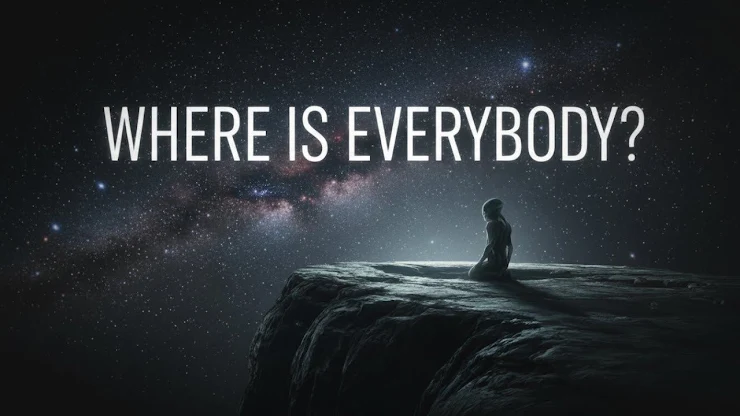
The Fermi Paradox is the contradiction between the high probability of intelligent extraterrestrial life and the lack of evidence for it.
Proposed by physicist Enrico Fermi in 1950, it highlights the question, "Where is everybody?" given the vastness of the universe and the potential for civilizations to have developed and spread over billions of years.
Elon Musk
play_arrow0:01 Where are the aliens? Fermi Paradox
The Why Files
play_arrow22:18 Fermi Paradox: If many advanced alien civilizations should exist in the universe, where are they?
play_arrow22:24 One answer: They're hiding
Fermi Paradox explained
Argument for alien life
The universe is incredibly old and vast, containing billions of galaxies, each with billions of stars. Many of these stars are likely to have planets, and some of those planets may have conditions suitable for life to emerge. If intelligent life arises, it could potentially develop and expand across the galaxy in a relatively short amount of cosmic time.
Lack of evidence
Despite the high likelihood, there is no conclusive evidence of any advanced extraterrestrial civilizations, either through direct contact or signals.
Core question
Given the above, where are all the aliens?
Answers
Intelligent life is rare
The Great Filter: There may be a significant barrier to the development of advanced life, either in our past or in our future.
Unique Earth: The specific conditions needed for intelligent life to arise on Earth may be exceptionally rare.
Intelligent life exists but we can't detect it
They are too far away: The distances are simply too vast for us to detect them or for them to have reached us.
We aren't looking correctly: We may be listening for the wrong types of signals, or their technology may be fundamentally different from our own.
They are deliberately hiding: The "zoo hypothesis" suggests that advanced civilizations are aware of us but choose not to interfere.
They are dangerous: The "dark forest theory" posits that civilizations remain silent out of fear that revealing themselves would lead to their destruction by other, more hostile civilizations.
Intelligent life is not interested
They may have no desire to communicate or expand.
Contact is not a priority for them.